



OSKALOOSA, Iowa – For more than two decades, Oskaloosa High School students have built a new home in the community each year through the school’s Building Trades program.
Now that hands-on classroom may soon run out of places to build.
The program has secured a lot for next year’s home, but after that, available building sites are uncertain. Without additional lots, one of Oskaloosa’s most unique real-world learning programs could face an uncertain future.
At the same time, the community itself faces a growing need for housing.
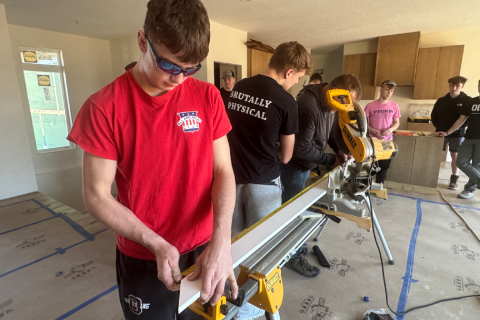
On the east side of Oskaloosa, Oskaloosa High School students are framing more than walls and rooflines. Inside a new home taking shape in the Fox Run neighborhood, students in Oskaloosa High School’s Building Trades program are gaining real-world construction experience while quietly contributing to a much larger community need: housing.
Each school year students in the Building Trades program construct a full-scale home from the ground up. This year’s project is a 1,800-square-foot house with three bedrooms, two bathrooms, and a three-car garage. The home is larger than typical builds because of its location in a newer neighborhood, where expectations for size and design are different.
For instructor David Bower, the work site is both a classroom and a proving ground for students interested in careers in the skilled trades.
“When I started, the construction class amounted to students building houses out of lollipop sticks and glue guns,” Bower said. “I just didn’t feel like they were getting any real, true hands-on experience. You’re putting actual, relevant work into application, and you just can’t beat the real-life experience.”
The program, which began building houses in 2003, now enrolls 27 students across two daily class blocks. Students spend multiple class periods at the build site learning carpentry, framing, mechanical systems, and project management.
The model reflects the same philosophy that drives the district’s Innovation Hub: learning by doing. Long before the Hub existed, the Building Trades program was already sending students into authentic work environments where their learning produced something tangible.
“We want to get kids out and get them in real-life working scenarios,” Bower said. “That was the whole premise of starting the building trades class.”
Those real-world experiences are increasingly important as communities across Iowa struggle to find skilled labor in construction and related fields. Bower said he keeps informal track of former students and has seen many move directly into trade careers after graduation.
But the homes students build do more than train the next generation of builders. Each project adds another house to the local housing inventory at a time when demand continues to outpace supply.
Housing studies conducted for Oskaloosa have repeatedly identified a growing shortage. One analysis projected demand for hundreds of additional housing units in Oskaloosa over the coming years as demographics shift and household formation continues.
More recent community planning efforts estimate the city is currently short more than 1,500 housing units and will need roughly 350 new homes by 2030 to keep pace with growth, or about 70 units each year.
That means the single home students build annually cannot solve the housing shortage alone, but it can help in two important ways.
First, it adds another home to the community’s housing stock. Second, it prepares students to enter the workforce and help build the many homes the region will need in the coming years.
“We’re teaching kids how to build,” Bower said. “We’ve got a number of students who have gone through the program who are now doing work related to the trades. That helps alleviate the shortage of people in the workforce. And we’re also adding houses every year to the housing stock.”
The future of the program, however, depends on something increasingly difficult to find: places to build.
For years, students constructed homes within the same subdivision until the lots were eventually filled. The Fox Run location utilized this year was one of the few remaining available sites.
“We’re out of lots where we had been building. That subdivision is completely filled up,” Bower said. “Going forward, we’re probably looking at infill lots or hoping there are new subdivisions.”
Building on scattered infill lots can be challenging for a student-led program because each location may require a different house style or design to fit the surrounding homes. New subdivisions with multiple lots allow students to build consistent models and simplify construction planning.
“In a newer subdivision we can build the house that we’re used to building,” Bower said. “Our sales go smoother there as well.”
For community leaders, that challenge also presents an opportunity.
If a developer or community partner were willing to collaborate on developing a small subdivision of 10 to 30 lots, the Building Trades program could continue producing homes while training students in the very skills needed to build the region’s future housing supply.

