



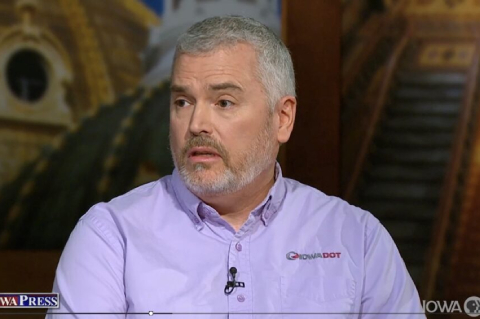
By O. Kay Henderson (Radio Iowa)
The number of traffic fatalities has dropped significantly in Iowa this year and could reach a 100-year low.
Some law enforcement officials cite Iowa’s new law banning the handling of a smart phone while driving as a major factor. Larry Grant, the state safety planner for the Iowa Department of Transportation, said officers have been issuing citations for the past six months and will start issuing citations January 1, so he expects the full effect of the law on traffic safety will occur in 2026.
“The public, they work around those laws a lot of times, so we’re hoping that once that’s enforceable that’s going to drive down crashes as a whole,” Grant told Radio Iowa. “That plays into, then, fatalities and serious injury crashes.”
A high percentage of traffic fatalities involve a single vehicle that runs off the road. “It tends to be a single occupant, sometimes impairment and then they aren’t wearing their seatbelt, which is very surprising,” Grant said, “that vehicle rolls and that person is either seriously injured or killed.”
As a result, Grant said the Iowa DOT’s new policy is that every road the agency builds in the future will have edge line rumble strips and, if it’s a two-lane road, there will be rumble strips along the center line. “Those marks on the road that are ground in, that when you drive over it makes that noise that alerts the driver they’re either crossing the center line or going off the edge of the road,” Grant said.
The DOT is also widening all paint strips that mark lanes on the road from four inches to six inches. “The newer vehicles, they’re looking for those edge line and center line markings,” Grant said, “and so with us increasing the size of those markings, it enhances the ability of that vehicle to actually see where the road is and keep that vehicle within the lanes of travel.”
During an interview with Radio Iowa last week, Grant indicated there have been “amazing improvements” to vehicles that are contributing to the drop in traffic fatalities and accidents overall.
“Vehicles are really made to absorb those crashes so they have crush zones. They have air bags, and then they have anti-lock brakes and then traction control — all this technology, then we really advanced it when it started doing lane assist or adaptive cruise control,” Grant said, “so all those things that vehicle is doing for the driver without the driver even, honestly, knowing that.”
Other roadway improvements are improving safety — and reducing wrecks — like high-intensity reflective signs, particularly on the curves of roads. “It makes that driver kind of look up a little bit and a lot of times when people are driving, they’re not focused on the roads, they’re looking down. We want to draw their attention to those safety signs that are out there, whether it’s stop signs or yield signs or, again, those chevrons around a curve,” Grant said. “Whether it’s in the daylight or at night when those headlights hit, it draws attention to those signs.”
Grant was a state trooper for nearly 30 years and has been the Iowa DOT’s State Safety Planner for the past three-and-a-half years.

